Vietnam CNC Manufacturing Ecosystem: Suppliers, Infrastructure and OEM Supply Chains
The Vietnam CNC manufacturing ecosystem connects precision machining companies, raw material distributors, industrial equipment suppliers, secondary processing providers, quality inspection services, and logistics partners to support domestic and international manufacturing.
For global OEM companies, the strength of this ecosystem matters as much as the machining capability of an individual supplier.
A CNC manufacturer may have suitable equipment and skilled operators, but reliable production also depends on material availability, cutting tools, heat treatment, surface finishing, inspection, packaging, and transportation.
Understanding how these supporting activities work together helps international buyers evaluate Vietnam’s manufacturing infrastructure and plan more resilient supply chains.
This guide examines the structure of Vietnam’s CNC manufacturing ecosystem, its main industrial regions, supporting industries, material sourcing considerations, and the practical requirements for long-term OEM production.
1. Understanding the Vietnam CNC Manufacturing Ecosystem
A manufacturing ecosystem is a network of companies, infrastructure, technical resources, and services that work together to produce and deliver industrial products.
In CNC manufacturing, the ecosystem extends far beyond the machine shop.
It includes several interconnected activities:
- Raw material procurement and distribution
- CNC machine tools and industrial equipment
- Cutting tools, fixtures, and consumables
- CAD/CAM programming and manufacturing engineering
- Precision machining and secondary operations
- Heat treatment and surface finishing
- Quality inspection and testing
- Industrial packaging and logistics
- Technical workforce development
Each activity contributes to the final quality, cost, and delivery performance of a manufactured component.
For example, a precision steel shaft may require material procurement, CNC turning, heat treatment, grinding, final inspection, corrosion protection, and export packaging.
Although the machining process may be completed by one manufacturer, other stages may involve specialized service providers.
The ability to coordinate these activities effectively is an important characteristic of a mature manufacturing supply chain.
2. Major CNC Manufacturing Regions in Vietnam
Vietnam’s industrial manufacturing activities are distributed across several regions, with important concentrations in the north and south.
Northern Vietnam: Hanoi and Surrounding Industrial Provinces
Northern Vietnam includes industrial manufacturing areas around Hanoi, Bac Ninh, Hai Phong, Hung Yen, and other nearby provinces.
This region supports a range of manufacturing activities, including mechanical engineering, electronics, industrial equipment, precision components, and supporting industries.
For CNC manufacturers, proximity to industrial customers, logistics providers, and supporting businesses can help simplify coordination.
The Hanoi region also provides access to engineering universities, technical training institutions, and an industrial workforce.
However, buyers should evaluate individual suppliers rather than assume that all manufacturers in the same region have equivalent capabilities.
Southern Vietnam: Ho Chi Minh City and Surrounding Industrial Areas
Southern Vietnam has an established manufacturing base around Ho Chi Minh City, Dong Nai, Binh Duong, and neighboring industrial areas.
The region includes mechanical manufacturing businesses, industrial component suppliers, equipment manufacturers, and export-oriented production operations.
Its manufacturing networks can support different stages of industrial production, from component machining to selected finishing and assembly processes.
Central Vietnam: Developing Industrial Opportunities
Central Vietnam includes industrial and logistics areas associated with cities and provinces such as Da Nang and Quang Ngai.
Depending on the project, manufacturers in this region may offer additional sourcing options.
For international OEM buyers, the choice of region should consider supplier capability, transportation arrangements, material availability, and proximity to other production partners.
The best manufacturing location is the one that can support the required technical and supply-chain performance—not necessarily the largest industrial center.
3. Raw Material Suppliers in Vietnam’s CNC Supply Chain
Raw material sourcing is one of the most important components of the CNC manufacturing supply chain in Vietnam.
Precision machining depends on materials with the correct chemical composition, mechanical properties, dimensions, and certification requirements.
Aluminum Supply
Aluminum alloys are widely used in CNC machining for industrial housings, structural components, brackets, fixtures, and lightweight mechanical parts.
Common specifications may include aluminum 6061, 6082, and 7075, depending on project requirements.
Material availability can vary by alloy, temper, product form, dimensions, and certification requirements.
Stainless Steel Supply
Stainless steel is commonly selected for corrosion-resistant mechanical components, industrial fittings, and precision parts.
Typical grades include 303, 304, and 316.
For OEM manufacturing, buyers should specify the required grade and relevant material standards rather than relying on generic descriptions.
Carbon Steel and Alloy Steel
Carbon and alloy steels are used for shafts, bushings, machine components, mechanical assemblies, and parts requiring specific strength or wear characteristics.
Certain applications may also require heat treatment or additional finishing processes.
Brass, Copper, and Bronze
These materials are used in industrial connectors, fittings, electrical components, and mechanical applications.
Availability and cost depend on the required alloy, form, dimensions, and supply conditions.
Domestic Distribution and Imported Materials
Vietnamese CNC manufacturers may obtain materials through domestic distributors or international supply channels.
Some materials are readily available through local industrial suppliers, while specialized grades or dimensions may require imports.
Therefore, buyers should confirm:
- Exact material grade and standard
- Available stock dimensions
- Country of origin, when relevant
- Material test certificates
- Batch identification requirements
- Minimum order quantities
- Procurement lead time
Material planning should begin during the quotation and technical review stages, particularly for recurring OEM production.
4. CNC Machine Tools, Cutting Tools and Technical Equipment
The availability of suitable machinery and supporting equipment influences the capabilities of precision machining suppliers.
CNC Machine Tools
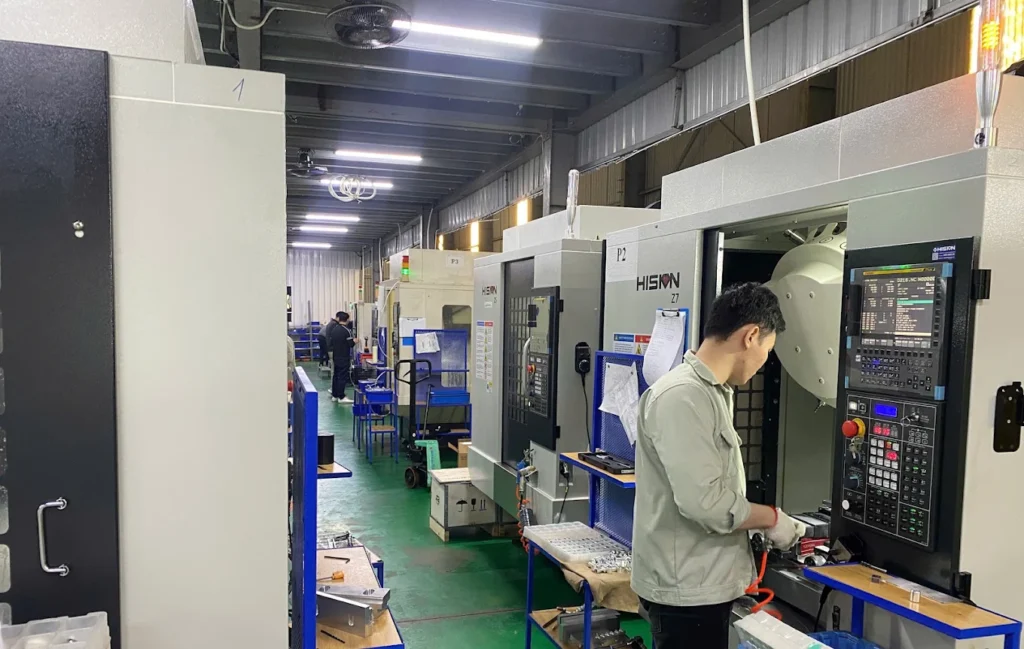
Vietnamese manufacturers use different types of CNC equipment depending on their production specialization.
These may include:
- CNC vertical machining centers
- CNC horizontal machining centers
- CNC turning centers
- Automated CNC lathes
- Multi-axis machining centers
- Specialized machining equipment
Equipment capability varies according to machine design, configuration, condition, tooling, and manufacturing process.
Cutting Tools and Tooling Systems
Precision machining requires appropriate cutting tools, inserts, tool holders, drills, taps, reamers, and other consumables.
Tool selection affects machining efficiency, dimensional accuracy, surface finish, and operating cost.
Tool availability can also affect production continuity.
For recurring OEM programs, manufacturers should consider critical tooling requirements and replacement lead times.
Workholding and Fixtures
Fixtures and workholding systems are essential for stable machining operations.
Appropriate fixturing can improve setup repeatability, reduce handling time, and support consistent dimensional control.
CAD/CAM and Manufacturing Engineering
Programming software and engineering expertise help convert customer drawings into executable manufacturing processes.
Manufacturers must select suitable machining strategies, cutting parameters, tools, and inspection methods.
Machine ownership alone does not determine manufacturing performance. The complete combination of equipment, tooling, engineering, and process control is what matters.
5. Supporting Industries and Secondary Manufacturing Processes
Many OEM components require additional manufacturing processes after CNC machining.
These processes are important elements of the wider Vietnam CNC manufacturing ecosystem.
Heat Treatment
Heat treatment may be required to achieve specified hardness, strength, or other material properties.
The exact process depends on the material and engineering requirements.
Surface Finishing
Common finishing requirements may include:
- Anodizing
- Electroplating
- Passivation
- Protective coating
- Polishing
- Blasting
- Other project-specific surface treatments
The suitability of each process depends on material, application, dimensional requirements, and customer specifications.
Precision Grinding
Grinding may be required for components with demanding surface finish, dimensional, or geometric requirements.
Welding and Assembly
Certain OEM projects involve machined components combined with welded parts, purchased components, or mechanical assemblies.
Cleaning and Packaging
Industrial components may require controlled cleaning, corrosion protection, identification, and protective packaging.
For international shipments, packaging must account for transportation conditions and the customer’s receiving requirements.
Managing External Processes
Not every CNC manufacturer performs every secondary operation internally.
A manufacturer may coordinate approved external suppliers for specialized processes.
In such cases, OEM customers should understand:
- Which operations are performed internally
- Which operations are outsourced
- How subcontractors are qualified
- How product specifications are communicated
- How inspection and traceability are maintained
- Who is responsible for final product conformity
This coordination is essential for integrated manufacturing and turnkey production programs.
6. Industrial Infrastructure Supporting CNC Manufacturing
Vietnam industrial manufacturing infrastructure includes industrial zones, transportation networks, ports, warehousing, utilities, and supporting services.
These resources influence the practical operation of manufacturing supply chains.
Industrial Zones and Manufacturing Clusters
Industrial zones can provide locations for manufacturing companies and supporting industrial businesses.
Proximity between manufacturers and service providers may simplify coordination, although actual benefits depend on the specific supplier network.
Transportation and Port Access
Export-oriented CNC manufacturers must coordinate domestic transportation and international shipments.
Depending on factory location and destination, shipments may use road transportation, seaports, airports, or combinations of these services.
Electricity and Factory Infrastructure
CNC production requires reliable electrical systems, suitable factory environments, equipment maintenance, and operational planning.
Manufacturers should maintain appropriate controls for equipment availability and production continuity.
Warehousing and Inventory Management
Raw material storage, work-in-progress control, finished-goods management, and product identification are important for recurring manufacturing programs.
For OEM customers, inventory planning can help manage material procurement lead times and planned production releases.
Logistics Coordination
International manufacturing programs require coordination among suppliers, freight providers, customs representatives, and customers.
The complete supply chain must account for manufacturing lead time, packaging, export documentation, transportation, and final delivery.
7. Quality Infrastructure and Inspection Capabilities
Quality assurance connects multiple stages of the manufacturing ecosystem.
A precision machined component must meet its engineering requirements regardless of how many companies participate in production.
Depending on the product, inspection activities may include:
- Incoming material verification
- First-part inspection
- In-process dimensional inspection
- Final product inspection
- Surface finish measurement
- Hardness testing
- Geometric measurement
- Material and process documentation
Manufacturers may use coordinate measuring machines, optical measurement equipment, micrometers, gauges, and other suitable instruments.
The choice of inspection method depends on the component’s technical requirements.
Why ISO 9001:2015 Matters
ISO 9001:2015 provides a framework for establishing and maintaining a quality management system.
For OEM customers, a structured quality system can support document control, process management, nonconformance handling, and continual improvement.
However, certification should not replace direct evaluation of manufacturing and measurement capability.
A qualified supplier must demonstrate that its processes can meet the actual component specifications.
8. How the OEM Manufacturing Supply Chain in Vietnam Works
An OEM manufacturing supply chain in Vietnam may involve several coordinated stages.
A typical example is:
Customer Drawing → Technical Review → Material Procurement → CNC Machining → Secondary Processing → Inspection → Packaging → Export Delivery
The sequence may vary according to the component and project requirements.
Technical Review
The manufacturer reviews drawings, tolerances, material specifications, quantities, and special requirements.
Material Procurement
Suitable raw materials are purchased according to the approved specifications.
CNC Machining
Components are manufactured using the selected machining processes.
Secondary Processing
Required finishing, treatment, cleaning, or assembly operations are performed.
Quality Verification
Components are inspected according to the agreed quality plan.
Packaging and Delivery
Finished parts are protected, identified, packed, and prepared for shipment.
Repeat Production
For recurring OEM orders, the manufacturer maintains appropriate production documentation, planning, inspection, and communication processes.
The key objective is to establish a repeatable manufacturing flow that can consistently meet customer expectations.
9. Common Supply Chain Challenges in Vietnam
International buyers should recognize that Vietnam’s CNC manufacturing ecosystem has both strengths and limitations.
Specialized Material Availability
Certain alloys, grades, or product forms may require additional procurement time.
Dependence on Imported Industrial Inputs
Some manufacturers rely on imported machine tools, cutting tools, specialized materials, and other equipment.
This can influence cost and supply continuity.
Different Levels of Supplier Maturity
Manufacturers vary in equipment, technical workforce, process control, documentation, and production management.
Secondary Process Coordination
Projects involving multiple external service providers require clear specifications and responsibilities.
Production Capacity Constraints
A supplier may have suitable equipment but insufficient available capacity for a particular delivery schedule.
Export and Logistics Planning
International shipments require coordination beyond the completion of machining operations.
These challenges should be assessed during supplier qualification and addressed through practical risk management.
10. Building a More Reliable CNC Manufacturing Supply Chain
For international OEM companies, reliable sourcing requires more than identifying a capable machine shop.
A practical approach includes several important activities.
Map the Manufacturing Process
Identify each production stage and determine which operations are performed internally or externally.
Confirm Material Sources
Verify material availability, required certifications, and procurement lead times.
Evaluate Critical Suppliers
Review the capabilities of important secondary processing and supporting service providers where relevant.
Establish Quality Requirements
Define inspection criteria, documentation, traceability, and product acceptance conditions.
Plan Production Capacity
Agree on realistic order quantities, lead times, production schedules, and forecast requirements.
Define Communication Responsibilities
Establish clear procedures for engineering changes, production updates, nonconformities, and delivery coordination.
Review Performance
Monitor quality, cost, delivery, and opportunities for improvement during repeat production.
A well-coordinated manufacturing supply chain reduces uncertainty and supports stronger long-term relationships.
11. TDB Hanoi: Precision CNC Manufacturing within Vietnam’s Industrial Ecosystem
TDB Hanoi is a Vietnamese precision manufacturing company established in 2015 and based in Hanoi, Vietnam.
We support international B2B and OEM customers with precision CNC machining and integrated manufacturing solutions.
Our capabilities include:
- CNC milling
- CNC turning
- Automated CNC lathe machining
- Contract manufacturing
- Turnkey manufacturing solutions for suitable projects
TDB Hanoi operates 50+ CNC machines and has a production capacity of up to 200,000 parts per month across its manufacturing operations.
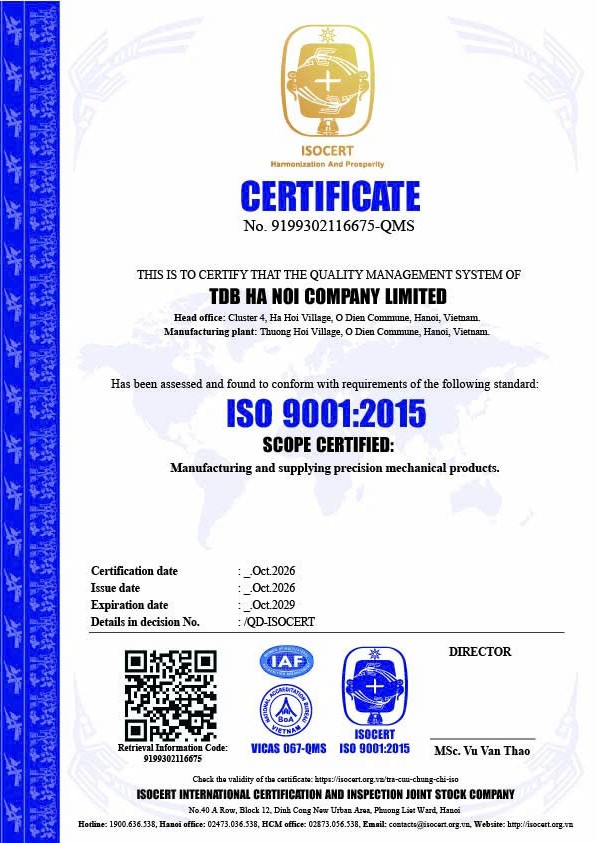
Our quality management system is certified to ISO 9001:2015.
For OEM customers, our approach is built around three priorities:
Quality
Manufacturing according to agreed drawings, specifications, inspection requirements, and quality standards.
Cost
Developing efficient processes and coordinating manufacturing activities to support competitive and sustainable production economics.
Delivery
Planning production and coordinating relevant manufacturing stages to support agreed delivery commitments.
These priorities form our Quality – Cost – Delivery (QCD) approach.
Our objective is to support long-term OEM relationships through consistent manufacturing performance, technical communication, and reliable repeat production.
For projects requiring additional manufacturing processes, the appropriate scope and coordination responsibilities are evaluated during technical review.
12. Conclusion: Why the Manufacturing Ecosystem Matters
The Vietnam CNC manufacturing ecosystem provides international OEM companies with opportunities to access precision machining capabilities and supporting industrial services.
However, the strength of a manufacturing supply chain cannot be measured by the number of CNC machines alone.
Reliable OEM production requires coordination between material suppliers, machining operations, supporting processes, quality management, industrial infrastructure, and logistics.
For international buyers, understanding these connections is essential when evaluating manufacturing partners in Vietnam.
A capable supplier should not only manufacture the required component but also manage the manufacturing activities necessary to deliver consistent quality, competitive costs, and dependable delivery.
Quality. Cost. Delivery. The Foundation of Every Long-Term Partnership.
Build Your CNC Manufacturing Supply Chain with TDB Hanoi
Are you evaluating precision machining or integrated OEM manufacturing in Vietnam?
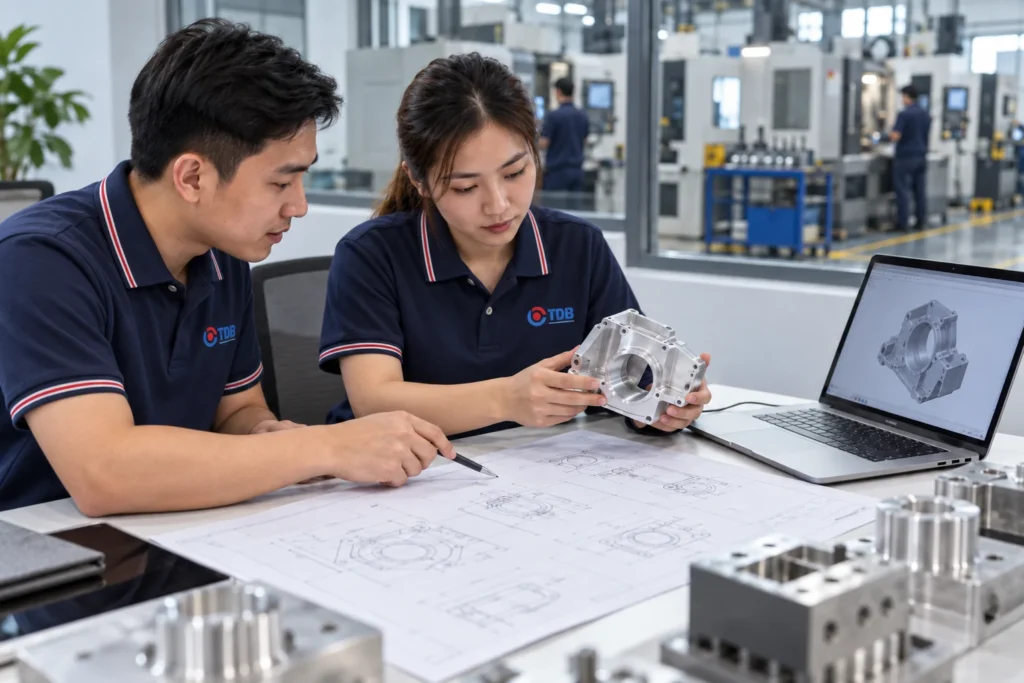
TDB Hanoi can review your component drawings, material requirements, production quantities, inspection specifications, and delivery expectations.
Our team will evaluate the appropriate manufacturing scope and production approach for your project.
Explore our manufacturing capabilities or request a quotation at www.tdb.com.vn.
Frequently Asked Questions
What is the Vietnam CNC manufacturing ecosystem?
The Vietnam CNC manufacturing ecosystem includes precision machining companies, material suppliers, tooling providers, secondary processing businesses, inspection resources, and logistics services that support industrial component manufacturing.
Where are CNC manufacturers located in Vietnam?
CNC manufacturing businesses operate in several regions, including industrial areas around Hanoi, Bac Ninh, Hai