CNC Machining Technology Vietnam: Milling, Turning and Automated OEM Manufacturing
CNC machining technology Vietnam is an increasingly relevant topic for international OEM manufacturers evaluating precision machining capabilities, production efficiency and long-term manufacturing partnerships in Southeast Asia.
Modern CNC manufacturing involves much more than operating computer-controlled machine tools. It combines manufacturing engineering, machine selection, cutting-tool technology, process planning, automation, dimensional inspection and production management.
For global OEM buyers, understanding these technologies is essential when evaluating whether a manufacturer can consistently produce components according to engineering drawings, quality requirements and delivery schedules.
Vietnamese precision machining companies use a range of CNC manufacturing processes, including milling, turning and automated lathe production, to support industrial components and repeat manufacturing programs.
This guide explains the technologies behind precision CNC machining in Vietnam, their practical applications, and the factors that determine manufacturing capability for international OEM projects.
1. Understanding CNC Machining Technology in Vietnam
Computer Numerical Control (CNC) machining is a manufacturing method in which programmed instructions control machine movements and cutting operations.
Unlike conventional manual machining, CNC equipment can execute defined toolpaths and machining sequences with repeatable programmed movements.
However, the accuracy and consistency of finished components depend on more than the CNC controller.
Important factors include:
- Machine condition and mechanical rigidity
- Manufacturing engineering and programming
- Cutting-tool selection
- Workholding and fixture design
- Material characteristics
- Cutting parameters
- Thermal stability
- Measurement and inspection
- Process monitoring and operator competence
A technically advanced machine cannot compensate for an unsuitable manufacturing process.
For this reason, OEM buyers should evaluate the complete production system rather than simply comparing machine brands or axis counts.
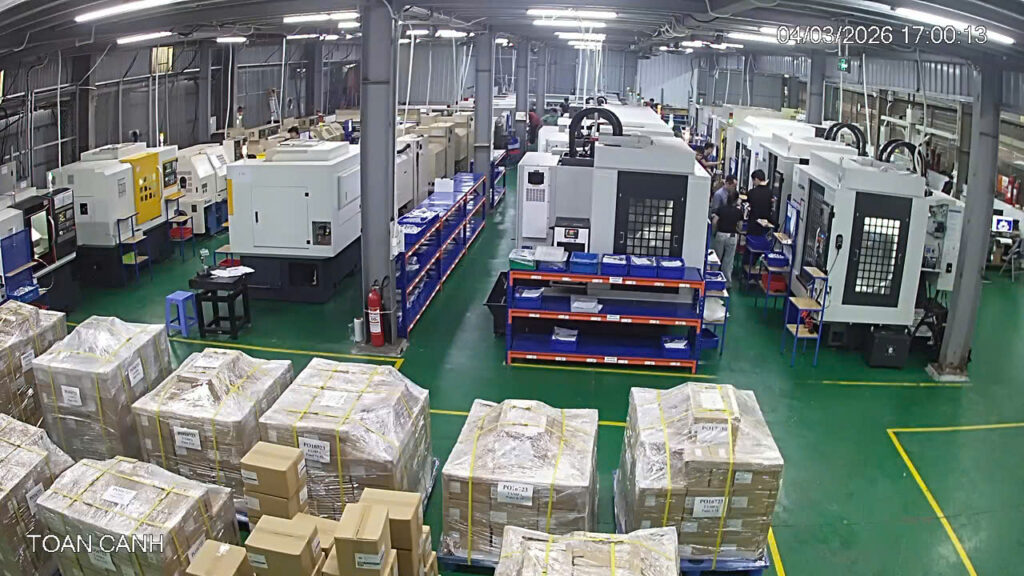
TDB Hanoi’s CNC machining capabilities provide an example of how milling, turning and automated lathe production can be organized to support different component requirements.
2. CNC Milling Technology for Precision Components
CNC milling uses rotating cutting tools to remove material from a workpiece.
The process is particularly suitable for components requiring flat surfaces, pockets, slots, holes, profiles and other geometric features.
Typical applications include:
- Industrial machine housings
- Equipment brackets
- Automation components
- Mechanical fixtures
- Aluminum enclosures
- Precision mounting plates
- Custom OEM mechanical parts
3-Axis CNC Milling
Three-axis milling machines generally control tool movement along the X, Y and Z axes.
They are suitable for many common machining operations, including facing, pocketing, drilling and contouring.
For components with multiple machining orientations, additional setups may be necessary.
Multi-Axis CNC Milling
Depending on machine configuration, additional rotary axes can allow the cutting tool or workpiece to approach features from different orientations.
This may reduce the number of setups required for certain complex components.
However, multi-axis machining is not automatically more economical or more accurate for every application.
The decision should consider geometry, tolerances, setup requirements, tooling and production volume.
Milling Stability and Tool Selection
Successful CNC milling depends on stable cutting conditions.
According to Sandvik Coromant’s milling application guidance, workpiece clamping, machine condition, tool length and cutting-force direction are important considerations for controlling vibration during milling.
Excessive vibration can affect surface finish, tool life and dimensional consistency.
For OEM manufacturing, the machining strategy should therefore be selected according to the actual component and production requirements.
Explore TDB Hanoi’s CNC machining services for an overview of its manufacturing processes.
3. CNC Turning Technology for Rotational Parts
CNC turning is commonly used to manufacture components with rotational geometry.
During conventional turning, the workpiece rotates while a cutting tool removes material to create the required features.
Common turned components include:
- Shafts
- Pins
- Bushings
- Sleeves
- Spacers
- Threaded connectors
- Industrial fittings
- Rotational housings
External and Internal Turning
External turning produces features on the outside of a rotating workpiece.
Internal turning and boring operations create or finish internal cylindrical features.
Threading and Grooving
CNC turning equipment can perform suitable threading and grooving operations according to the component design and machine configuration.
These processes are commonly used in industrial connectors, fittings and mechanical assemblies.
Dimensional Control
Turning accuracy depends on machine condition, tooling, material behavior, workholding, process stability and inspection.
For long or slender components, workpiece deflection and vibration may require particular attention.
Repeat Production
A validated turning process can support recurring orders when manufacturing conditions, tooling, inspection requirements and engineering revisions are properly controlled.
TDB Hanoi’s CNC turning services support suitable rotational components and long-term OEM manufacturing programs.
4. Automated CNC Lathe Technology
Automated CNC lathes can support efficient manufacturing of selected rotational components, particularly where production volumes and component geometry justify an automated approach.
Depending on the equipment configuration, automated turning systems may incorporate bar feeding, automatic part handling or additional machining functions.
Why Automation Matters
Automation can reduce certain manual handling activities and help maintain consistent operating sequences.
Potential benefits include:
- More consistent material feeding
- Reduced manual loading time
- Improved repeatability of programmed operations
- Better machine utilization under suitable conditions
- More predictable production cycles
- Support for recurring component orders
However, the economic value of automation depends on production volume, cycle time, tooling, equipment utilization and maintenance requirements.
Automated Turning and Swiss-Type Machining
Automated CNC turning and Swiss-type turning are related but not identical technologies.
Swiss-type machines typically use a sliding headstock and guide-bushing arrangement to support suitable small-diameter or slender components.
Other automated lathes may use different machine configurations.
Buyers should confirm the actual machine type and its capabilities rather than assuming all automated turning equipment is Swiss-type.
Applications for OEM Manufacturing
Automated lathe production may be appropriate for:
- Small precision shafts
- Threaded fittings
- Connectors
- Pins
- Bushings
- Repetitive turned components
The final process selection should be based on engineering drawings, material specifications, production quantities and tolerance requirements.
TDB Hanoi provides automated CNC lathe services for suitable precision turning applications.
5. CNC Milling and Turning Technology: Choosing the Right Process
Selecting between milling and turning is one of the first technical decisions in CNC manufacturing.
The choice depends primarily on component geometry, required features, production quantities and manufacturing constraints.
| Evaluation Factor | CNC Milling | CNC Turning |
|---|---|---|
| Typical geometry | Prismatic or irregular | Rotational or cylindrical |
| Primary motion | Rotating cutting tool | Rotating workpiece |
| Common features | Pockets, slots, profiles, holes | Diameters, shoulders, bores, threads |
| Typical components | Housings, brackets, plates | Shafts, bushings, fittings |
| Main considerations | Setup orientation, rigidity, tool access | Workholding, deflection, concentricity |
Some components require both milling and turning operations.
Depending on available equipment and component design, these operations may be completed on separate machines or through suitable combined machining configurations.
The objective is not to use the most complex technology available.
It is to select the manufacturing process that can meet the technical requirements with stable quality and appropriate cost.
6. CAD/CAM Programming and Manufacturing Engineering
Advanced CNC machining Vietnam projects depend on effective manufacturing engineering as well as machine capability.
Computer-Aided Design (CAD) systems are used to create or interpret component geometry.
Computer-Aided Manufacturing (CAM) systems help engineers develop machining strategies and generate toolpaths for suitable CNC operations.
Engineering Drawing Review
Before programming, the manufacturing team should evaluate:
- Component geometry
- Material specification
- Dimensional tolerances
- Geometric tolerances
- Surface finish requirements
- Critical characteristics
- Production quantity
- Inspection requirements
Process Planning
Manufacturing engineers determine the machining sequence, machine selection, tooling, fixtures and inspection approach.
CNC Programming
CNC programs control machine operations according to the selected manufacturing strategy.
Programming requirements vary by controller, machine configuration and manufacturing process.
Setup and Initial Validation
Before recurring production, initial components should be checked to confirm that the manufacturing process can meet the approved requirements.
Engineering Revision Control
OEM projects often involve design updates.
A controlled manufacturing system should ensure that the correct drawing revision and corresponding production instructions are used.
Effective engineering control is particularly important when components move from initial sample development into repeat production.
7. Cutting Tools and Process Optimization
Cutting-tool technology directly affects manufacturing efficiency, component quality and production cost.
Different materials and component geometries require different machining approaches.
Tool Geometry
Tool geometry influences cutting forces, chip formation, surface finish and tool performance.
Cutting Speed and Feed Rate
Cutting parameters must be selected according to material properties, tool specifications, machine capability and process conditions.
Tool Wear
Cutting tools gradually wear during machining.
Uncontrolled tool wear can affect dimensional accuracy, surface quality and manufacturing stability.
Coolant and Chip Control
Suitable cooling, lubrication and chip evacuation methods can improve machining stability for applicable operations.
Machining Economics
Tooling decisions should consider not only tool purchase price but also cycle time, tool life, machine utilization and component quality.
Sandvik Coromant’s metal cutting knowledge resources cover turning, milling, threading, tool selection and machining optimization.
For OEM buyers, a manufacturer’s ability to manage these technical factors can be more important than the age or brand of an individual machine.
8. Precision CNC Manufacturing Technology and Quality Control
Precision CNC manufacturing technology must be supported by suitable measurement and quality management systems.
Programmed machine movement does not guarantee that every finished component will meet its drawing requirements.
Dimensional variation can result from:
- Tool wear
- Thermal changes
- Machine condition
- Workholding variation
- Material differences
- Setup errors
- Programming mistakes
- Measurement uncertainty
First Article Inspection
Initial components can be inspected against the approved drawing and applicable customer requirements before recurring production begins.
In-Process Inspection
Critical dimensions may be monitored during production to identify deviations before they affect larger quantities.
Coordinate Measuring Machines
Coordinate Measuring Machines (CMMs) can support dimensional verification of suitable geometric features.
However, measurement capability depends on the equipment, setup, measurement method and inspection conditions.
Final Inspection
Finished parts should be checked according to the agreed inspection plan and acceptance requirements.
Quality Documentation
Depending on customer requirements, manufacturing programs may include:
- Dimensional inspection reports
- Material certificates
- First Article Inspection reports
- Process control plans
- PPAP documentation
- Certificates of Conformance
- Traceability records
TDB Hanoi integrates incoming, in-process and final inspection within its CNC machining quality control system.
For long-term OEM manufacturing, quality control should be part of the complete production process rather than a final activity performed only before shipment.
9. Automated CNC Manufacturing Vietnam: Benefits and Limitations
Automated CNC manufacturing Vietnam is relevant to international buyers seeking stable production processes and scalable manufacturing capacity.
Automation may improve manufacturing performance when applied to suitable operations.
Production Consistency
Automated operations can reduce certain sources of manual variation.
However, process stability still depends on tooling, maintenance, setup and quality control.
Manufacturing Efficiency
Reducing non-cutting time can improve equipment utilization for appropriate components and production volumes.
Production Planning
Repeatable machining cycles can support more predictable capacity planning.
Workforce Development
Automation changes the skills required in manufacturing.
Programming, setup, maintenance, troubleshooting and process improvement remain essential.
Limitations of Automation
Automation is not necessarily the best solution for every CNC project.
Low-volume components, frequent engineering changes or highly variable product mixes may require a more flexible production approach.
OEM buyers should therefore evaluate whether a supplier’s automation strategy matches the actual manufacturing program.
10. How CNC Technology Affects Manufacturing Cost and Lead Time
CNC technology influences manufacturing economics through several interconnected factors.
Machine Selection
Using the appropriate machine can reduce unnecessary processing complexity.
Setup Time
Components requiring multiple setups may involve additional handling, fixturing and inspection activities.
Cycle Time
Machining time is influenced by material, geometry, cutting parameters, tooling and machine capability.
Tooling and Fixtures
Specialized tooling or fixtures may increase initial costs but provide benefits during repeat production.
Inspection Requirements
Tight tolerances and extensive documentation can increase inspection time and manufacturing cost.
Production Volume
Larger recurring orders may allow manufacturers to optimize setups, tooling and production planning.
Equipment Utilization
Available machine capacity and production scheduling influence achievable lead times.
For international OEM sourcing, manufacturing cost should be evaluated together with quality and delivery performance.
A lower unit price is not necessarily the lowest total manufacturing cost when rework, delays or inconsistent production are considered.
11. Evaluating CNC Manufacturing Technology for OEM Projects
When assessing a CNC supplier in Vietnam, international buyers should ask practical technical questions.
1. Equipment suitability: Does the supplier have the right machines for the required component geometry and dimensions?
2. Programming capability: Can the engineering team develop and maintain suitable manufacturing programs?
3. Process stability: How are machining parameters, tooling and setups controlled?
4. Dimensional verification: What measurement methods are available for critical characteristics?
5. Production capacity: Can the supplier support the required monthly or annual quantities?
6. Engineering changes: How are drawing revisions communicated and implemented?
7. Quality documentation: Can the supplier provide the records required by the customer?
8. Repeat production: Can the manufacturing process be maintained consistently across multiple orders?
9. Supporting processes: How are required finishing, treatment or assembly operations coordinated?
10. Technical communication: Can the supplier identify manufacturing risks and clarify drawing requirements before production?
These questions help buyers assess actual manufacturing capability rather than relying on promotional claims.
12. TDB Hanoi: CNC Manufacturing Technology for Global OEM Customers
TDB Hanoi is a precision manufacturing company established in Hanoi, Vietnam, in 2015.
We support international B2B and OEM customers with CNC machining and integrated manufacturing solutions.
Our manufacturing operations include:
- 10 CNC milling machines
- 21 CNC turning machines
- 19 automated CNC turning machines
Together, these provide a manufacturing base of 50 CNC machines, with overall production capacity of up to 200,000 parts per month.
Our manufacturing approach supports suitable programs from technical review and initial production through validation, repeat production and long-term supply.
CNC Milling
Manufacturing suitable precision components with machined surfaces, pockets, holes and custom geometric features.
CNC Turning
Producing rotational components according to approved drawings and manufacturing requirements.
Automated CNC Lathe Production
Supporting selected precision turned components and recurring production programs.
Quality Management
TDB Hanoi operates under an ISO 9001:2015-certified quality management system.
Quality control includes incoming, in-process and final inspection according to applicable project requirements.
Integrated Manufacturing
For suitable projects, TDB Hanoi can coordinate agreed supporting processes through its turnkey manufacturing solutions.
Our manufacturing philosophy is based on three essential principles:
Quality: Produce components according to approved technical and quality requirements.
Cost: Develop efficient and sustainable manufacturing processes.
Delivery: Coordinate production planning to meet agreed customer commitments.
Together, these principles form our Quality – Cost – Delivery (QCD) approach.
We aim to build long-term manufacturing partnerships based on consistent production performance, responsive technical communication and continuous improvement.
13. Conclusion: Technology Must Support Reliable OEM Production
CNC machining technology in Vietnam offers international manufacturers access to different machining processes and production approaches.
CNC milling, CNC turning, automated lathe systems, manufacturing engineering and quality inspection each play a role in producing precision components.
However, advanced equipment alone does not guarantee manufacturing performance.
Reliable OEM production requires the appropriate combination of machine capability, engineering knowledge, process control, measurement and production management.
For global purchasing teams, the most important question is not simply which CNC machines a supplier operates.
It is whether the supplier can repeatedly manufacture the required components according to agreed quality, cost and delivery expectations.
Quality. Cost. Delivery. The Foundation of Every Long-Term Partnership.
Looking for a Reliable CNC Manufacturing Partner in Vietnam?
TDB Hanoi supports international OEM customers with precision CNC machining, automated turning and suitable integrated manufacturing solutions.
Send us your engineering drawings, material specifications, estimated production quantities, tolerances and inspection requirements.
Our team will review your project and evaluate an appropriate manufacturing approach.
Explore our CNC machining services in Vietnam or visit TDB Hanoi to request a quotation.
Frequently Asked Questions
What CNC machining technologies are used in Vietnam?
Vietnamese precision machining companies use CNC milling, CNC turning, automated lathes and other equipment configurations depending on their capabilities and production specialization.
What is the difference between CNC milling and CNC turning?
CNC milling typically uses a rotating cutting tool to machine a workpiece, while conventional CNC turning rotates the workpiece against a cutting tool. The appropriate process depends on component geometry and manufacturing requirements.
Is automated CNC machining suitable for high-volume OEM production?
Automated CNC machining can be suitable for recurring production when component geometry, production quantities and process stability justify automation.
Does multi-axis CNC machining always improve accuracy?
No. Multi-axis machining can reduce setups for suitable components, but accuracy still depends on machine condition, fixturing, tooling, programming, process control and measurement.
How can OEM buyers evaluate CNC manufacturing technology in Vietnam?
Buyers should assess equipment suitability, engineering capability, production capacity, process stability, inspection methods, quality documentation and repeat-production performance.
Can TDB Hanoi support long-term OEM manufacturing?
TDB Hanoi supports suitable programs from initial production and validation through repeat manufacturing, quality control and long-term supply according to agreed customer requirements.