Aluminium Profile CNC Machining in Vietnam for European OEMs
European OEMs sourcing aluminium components often require more than a basic extruded profile.
The profile may need to be cut to length, CNC milled, drilled, tapped, finished and inspected before it can enter an assembly or series-production process.
For these projects, the manufacturing challenge is not simply sourcing aluminium. It is controlling the complete transition from profile specification to finished component according to the engineering drawing and agreed quality requirements.
TDB Hanoi provides CNC machining and manufacturing support in Vietnam for custom aluminium components and profiles serving global markets, including European manufacturing programmes.
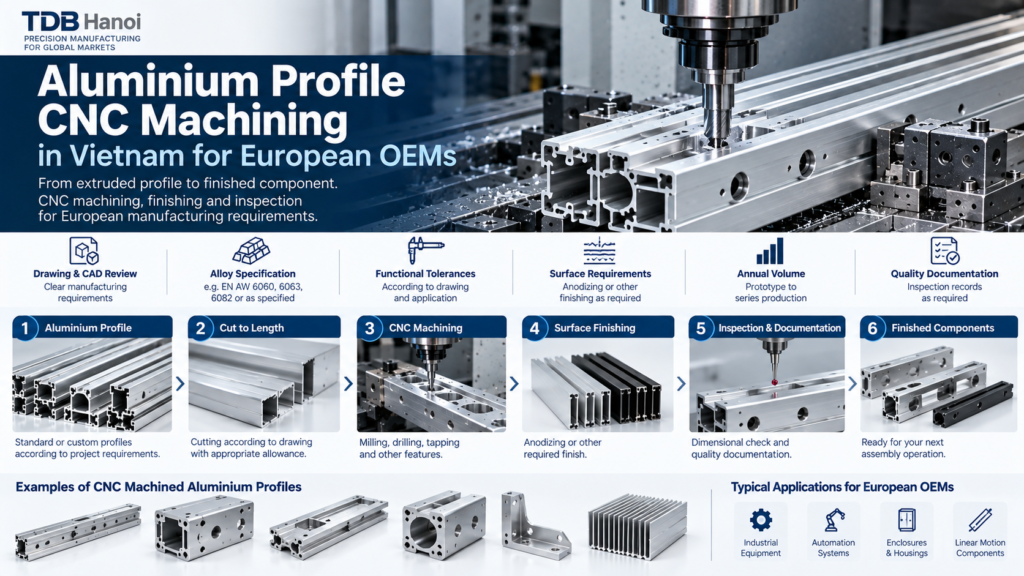
[IMAGE 1 – Aluminium Profile CNC Machining in Vietnam for European OEMs]
What Is Aluminium Profile CNC Machining?
Aluminium profile CNC machining is the secondary machining of an already manufactured aluminium profile to create the dimensions, holes, threads, slots, pockets, interfaces and other precision features required by the finished component.
The extrusion creates the basic cross-section.
CNC machining then creates features that require additional dimensional or geometric control.
A typical manufacturing route may be:
Aluminium Profile → Cut to Length → CNC Machining → Surface Finishing → Inspection & Documentation → Finished Component
This approach is widely relevant to industrial components where a repeated profile geometry must be converted into a drawing-controlled finished part.
Why Do Extruded Aluminium Profiles Need CNC Machining?
Extrusion is highly effective for producing a repeated cross-sectional geometry.
However, the finished component may also require:
- Precision holes
- Threads
- Mounting interfaces
- Slots
- Pockets
- Counterbores
- Countersinks
- Localised machined surfaces
- End machining
- Datum features
- Assembly features
These requirements cannot always be produced by the extrusion process itself.
CNC machining allows the manufacturer to add the local features required by the final engineering design.
European aluminium suppliers themselves commonly combine extrusion with CNC machining, sawing, surface treatment and assembly, illustrating the importance of secondary processing in converting a profile into a finished industrial component.
Aluminium Profile Machining for European Series Production
European procurement teams frequently evaluate a supplier not only for its ability to produce the first acceptable component, but also for its ability to repeat the manufacturing process across future batches.
For series production, the manufacturing system may need to control:
- Material specification
- Profile source
- Drawing revision
- Cutting
- CNC programme
- Fixtures
- Tooling
- Critical characteristics
- Inspection requirements
- Surface treatment
- Packaging
- Repeat orders
This makes process consistency as important as individual-part inspection.
German aluminium machining specialists, for example, commonly request technical drawings or CAD data together with alloy, functional tolerances, order quantity, planned annual requirement, surface requirements and delivery needs when evaluating series work.
Start With the Engineering Drawing
For European industrial projects, manufacturing should begin with controlled technical information.
A useful project package may contain:
- 2D engineering drawing
- 3D CAD model
- Drawing revision
- Aluminium profile drawing
- Material specification
- Order quantity
- Planned annual requirement
- Functional tolerances
- GD&T where applicable
- Surface requirements
- Inspection requirements
- Required documentation
- Packaging requirements
- Delivery requirements
The drawing should distinguish between the geometry created by the profile and the features requiring secondary machining.
Our CNC Machining Drawing Requirements guide explains this in greater detail.
Aluminium Alloy Specification
Material designation should be clearly communicated during RFQ.
European aluminium drawings may use EN AW designations.
Common profile alloys in the European supply chain can include grades such as:
- EN AW-6060
- EN AW-6063
- EN AW-6005A
- EN AW-6082
For example, European profile manufacturer Knauf Interfer publicly lists these among its standardised aluminium profile qualities.
This does not mean every grade is interchangeable or automatically available for every TDB Hanoi project.
The customer’s specified material should be reviewed together with:
- Component function
- Profile geometry
- Mechanical requirements
- Machining requirements
- Surface treatment
- Availability
- Required documentation
TDB Hanoi works with aluminium as part of our broader CNC Machining Materials capability.
EN AW Material Designations and US Alloy Designations
European buyers may specify aluminium differently from US customers.
For example, an engineering drawing may use an EN AW material designation rather than simply identifying the alloy by a four-digit number.
The manufacturing team should work from the material specification stated in the controlled project documentation rather than assuming equivalence.
If a buyer permits alternative material specifications, this should be clarified before quotation and production.
This is particularly important for international sourcing where engineering documentation may cross different material-standard systems.
CNC Operations for Aluminium Profiles
Cutting to Length
The first secondary operation is often cutting the profile to the required component length.
The cutting process should consider:
- Finished length
- Machining allowance
- End-face requirements
- Subsequent operations
- Inspection requirements
CNC Milling
Milling can produce:
- Slots
- Pockets
- Cut-outs
- Mounting faces
- Localised precision surfaces
- Complex machined features
Learn more about CNC Milling Services at TDB Hanoi.
Drilling
Drilling may create holes for:
- Assembly
- Fasteners
- Locating features
- Mounting
- Subsequent tapping
Hole diameter, position, depth and tolerance should be defined according to the drawing.
Tapping
Thread requirements should identify, where applicable:
- Thread specification
- Nominal size
- Pitch
- Thread depth
- Through or blind condition
The manufacturer should not need to infer critical thread requirements from CAD geometry alone.
Functional Tolerances for Machined Aluminium Profiles
Not every dimension on an aluminium profile requires the same level of control.
The key question is:
Which dimensions and geometric relationships are critical to the function of the finished component?
These may include:
- Mounting surfaces
- Hole positions
- Mating interfaces
- Assembly datums
- Bearing locations
- Sealing areas
- Parallel surfaces
- Perpendicular features
Tolerances should be defined according to the component’s functional requirements.
Unnecessarily restrictive tolerances can increase manufacturing and inspection effort without improving component performance.
Read our Tight Tolerance CNC Machining Guide for additional engineering considerations.
Extrusion Tolerances and Machined Features Are Different
An important distinction is that as-extruded geometry and CNC-machined geometry are created by different manufacturing processes.
The engineering drawing should therefore identify which characteristics depend on:
Extrusion → Cutting → CNC Machining → Finishing
If a particular interface requires additional precision, that surface or feature may require secondary machining.
CNC machining can create controlled local features according to the drawing, but it should not be assumed that every untouched section of an extruded profile automatically has the same dimensional characteristics as a machined surface.
GD&T for Aluminium Profile Components
Profile-based components may contain geometric requirements such as:
- Straightness
- Flatness
- Parallelism
- Perpendicularity
- Position
- Profile
- Datum relationships
Long or structurally complex profiles can make datum selection particularly important.
A drawing should communicate how critical machined features relate to the functional reference system of the component.
Read our GD&T for CNC Machined Parts guide.
Surface Treatment and Finishing
European aluminium components may require additional surface treatment after machining.
Depending on the project, this may include anodising, coating or another specified finishing process.
European extrusion companies commonly integrate CNC processing with anodising, painting or powder coating as part of the route from profile to finished component.
Surface treatment should be defined before production because it can affect:
- Appearance
- Corrosion resistance
- Surface properties
- Dimensional requirements
- Masking
- Threads
- Fits
- Inspection
- Manufacturing sequence
See our CNC Machining Surface Finishes guide.
Inspection of CNC Machined Aluminium Profiles
Inspection should be based on the drawing and agreed project requirements.
Depending on the component, this may include:
- Overall dimensions
- Machined dimensions
- Hole locations
- Thread requirements
- Critical interfaces
- GD&T characteristics
- Surface requirements
- Visual requirements
The inspection method should correspond to the characteristic being evaluated.
The objective is not to generate documentation for its own sake.
The objective is to provide the evidence required by the customer to confirm that agreed manufacturing requirements have been met.
Learn more about CNC Machining Quality Assurance at TDB Hanoi.
What Quality Documentation Should European Buyers Specify?
The required quality documentation should be agreed during RFQ rather than assumed after production.
Depending on the project and customer requirements, documentation may include:
- Inspection records
- Dimensional reports
- Material documentation
- First-article documentation
- Project-specific quality records
Not every order requires the same documentation package.
Buyers should identify which records are actually required for supplier approval, incoming inspection or series-production control.
This helps the manufacturer include the necessary inspection and documentation work during quotation.
What About EN 10204 Material Certificates?
European buyers may request material documentation according to their project requirements.
Where a specific certificate type or material document is required, it should be stated during RFQ and confirmed with the responsible material supply chain before production.
TDB Hanoi should not automatically promise an EN 10204 certificate for every aluminium profile project.
Instead, the requirement should be reviewed according to:
- Material source
- Customer specification
- Required certificate type
- Traceability requirements
- Project documentation
This approach avoids creating documentation assumptions that cannot be supported by the actual material supply route.
From Prototype to Series Production
A component can evolve significantly between prototype and recurring series manufacture.
During prototype development, priorities may include:
- Design verification
- Manufacturability
- Feature accessibility
- Tolerance validation
- Assembly testing
As the project moves toward series production, additional priorities become important:
- Stable material specification
- Repeatable fixtures
- CNC programme control
- Tooling strategy
- Inspection plan
- Surface finishing
- Packaging
- Batch consistency
- Repeat-order planning
Our Prototype to Series Production in Vietnam guide discusses this transition in greater detail.
Annual Volume Matters
European buyers should communicate both the initial order quantity and expected annual requirement where possible.
For example:
Prototype quantity ≠ Series batch quantity ≠ Annual demand
These quantities can influence:
- Material sourcing
- Fixture design
- Production planning
- Tooling
- CNC cycle optimisation
- Inspection strategy
- Packaging
- Commercial quotation
This is why established European CNC aluminium suppliers explicitly request planned annual demand as part of project evaluation.
Standard Profile or Custom Extrusion?
Not every machined aluminium component requires a custom extrusion.
If a standard profile provides suitable base geometry, the manufacturing route may be:
Standard Profile → Cutting → CNC Machining → Finishing → Inspection
A custom extrusion may be appropriate where the required cross-section is unique.
The decision should consider:
- Cross-sectional geometry
- Production quantity
- Annual demand
- Tooling
- Material
- Design maturity
- Lead time
- Total manufacturing cost
For early prototypes or frequently changing designs, machining from standard stock may sometimes provide greater flexibility.
European Supplier Qualification: What Should Buyers Evaluate?
A European procurement team should evaluate more than machine availability.
Important questions include:
Can the supplier interpret the drawing?
The manufacturer should understand material, tolerances, GD&T, surface requirements and critical features.
Is the manufacturing process appropriate for series production?
The process should be evaluated according to actual geometry and expected volume.
How are critical characteristics inspected?
Inspection should be tied to drawing requirements.
How is drawing revision controlled?
Repeat production should use the correct approved technical information.
Can the supplier support required documentation?
Documentation requirements should be agreed before production.
How will repeat orders be managed?
Material, machining, finishing, inspection and packaging requirements should remain controlled across recurring orders.
German buyers can also read our CNC Supplier in Vietnam for German Companies guide.
Why Consider Vietnam for European Aluminium Components?
Vietnam can provide European manufacturers with an additional manufacturing source as part of a diversified global supply chain.
However, supplier selection should not be based on labour cost alone.
European buyers should evaluate:
- Technical capability
- Engineering communication
- Quality system
- Material sourcing
- Manufacturing capacity
- Documentation
- Repeat-production capability
- Logistics
- Total landed cost
- Supply-chain risk
The objective is not simply to find the lowest quotation.
It is to develop a manufacturing source capable of supporting the required product over time.
US vs European Requirements for Aluminium Profile Projects
The underlying engineering principles remain the same, but procurement emphasis can differ.
US programmes may place strong emphasis on:
- Supplier diversification
- Finished-component sourcing
- Responsiveness
- Commercial flexibility
- Total landed cost
European and German programmes often place particularly strong emphasis on:
- Controlled technical drawings
- Material designation
- Functional tolerances
- Quality documentation
- Series-production processes
- Repeatability
These are not absolute differences, but they help explain why TDB Hanoi maintains separate buyer guides for different markets.
US buyers can read our companion guide: CNC Machined Aluminum Extrusions in Vietnam for US OEMs.
Aluminium Profile CNC Machining at TDB Hanoi
TDB Hanoi is a precision manufacturing company in Vietnam serving global markets.
Our manufacturing operations include:
- CNC Milling
- CNC Turning
- Automated CNC Lathe machining
- CNC machining of custom components
- Contract Manufacturing
- Turnkey Manufacturing
- Quality inspection and manufacturing support
TDB Hanoi currently operates 50+ CNC machines with production capacity of up to 200,000 parts per month across our manufacturing operations.
For aluminium profile projects, TDB Hanoi can review CNC machining requirements according to the customer’s drawing and agreed project requirements.
Where an extruded profile is required, the profile specification, material source and responsibilities should be defined during project review.
TDB Hanoi does not claim that aluminium extrusion itself is performed in-house unless this is explicitly confirmed for the individual project.
This distinction is particularly important for European supplier qualification and documentation.
What Should European Buyers Send for an RFQ?
For efficient technical review, send:
- 2D engineering drawing
- 3D CAD model
- Profile drawing
- Drawing revision
- Aluminium alloy/designation
- Initial quantity
- Series batch quantity
- Planned annual requirement
- Tolerances
- GD&T
- Surface requirements
- Secondary processes
- Inspection requirements
- Required quality documentation
- Packaging requirements
- Delivery requirements
The more complete the manufacturing information, the easier it is to evaluate the appropriate production route.
Frequently Asked Questions
What is aluminium profile CNC machining?
Aluminium profile CNC machining is the secondary machining of an aluminium profile to create finished features such as holes, threads, slots, pockets, mounting surfaces and precision interfaces according to an engineering drawing.
Can extruded aluminium profiles be CNC machined?
Yes. Already-manufactured aluminium profiles can be cut and CNC machined to create additional features required by the finished component.
What information is needed to quote an aluminium profile machining project?
A supplier typically needs the drawing or CAD data, material specification, profile information, quantity, annual requirement, tolerances, surface requirements, inspection requirements and required documentation.
What aluminium alloy should European buyers specify?
The alloy should follow the engineering requirements and controlled material specification. European drawings may use EN AW designations. The required grade should be stated rather than assumed.
Can CNC machining improve local precision on an extruded profile?
CNC machining can create controlled local surfaces and features according to drawing requirements. This does not mean untouched as-extruded geometry automatically has the same characteristics as CNC-machined features.
Should material certificates be requested before quotation?
If a specific material certificate or documentation package is required, it should be stated during RFQ so availability and project requirements can be confirmed before production.
Does TDB Hanoi extrude aluminium profiles in-house?
TDB Hanoi provides CNC machining and manufacturing support for aluminium components and profiles. Where extrusion is required, the extrusion source and project responsibilities should be confirmed during quotation rather than assuming extrusion is performed in-house.
Can TDB Hanoi support series production?
Yes. TDB Hanoi supports repeat manufacturing programmes and currently operates more than 50 CNC machines with production capacity of up to 200,000 parts per month across its manufacturing operations.
Send Your Aluminium Profile Project to TDB Hanoi
If your European manufacturing programme requires CNC machining of aluminium profiles, send TDB Hanoi your technical package for review.
Please include:
2D Drawing · 3D CAD · Profile Drawing · Aluminium Specification · Quantity · Annual Requirement · Tolerances · GD&T · Surface Requirements · Inspection & Documentation Requirements
Our team can review the CNC machining and manufacturing requirements before quotation.