CNC Machined Aluminum Extrusions in Vietnam for US OEMs
For many OEM components, aluminum extrusion creates the basic profile—but extrusion alone does not create the finished part.
The profile may still require precision cutting, CNC milling, drilling, tapping, slots, pockets, surface finishing, dimensional inspection, and other secondary operations before it is ready for assembly.
For US companies developing manufacturing sources in Vietnam, this creates an important sourcing opportunity: combine the material efficiency of an extruded aluminum profile with precision CNC machining to produce finished or near-finished OEM components.
TDB Hanoi supports CNC machining of aluminum profiles and custom aluminum components for global manufacturing programs, from initial orders to repeat production.
What Are CNC Machined Aluminum Extrusions?
CNC machined aluminum extrusions are aluminum profiles that are extruded to create a consistent cross-section and then CNC machined to add the precision features required by the finished component.
Typical secondary CNC operations can include:
- Cutting to length
- Milling
- Drilling
- Tapping
- Boring
- Slots
- Pockets
- Counterbores
- Countersinks
- Mounting features
- Precision interfaces
This combination is useful when the basic geometry repeats along the length of the component but individual sections require additional precision features.
Instead of machining the complete geometry from a solid aluminum block, the extrusion creates the basic cross-section first.
CNC machining then creates the features that cannot be produced by extrusion alone.
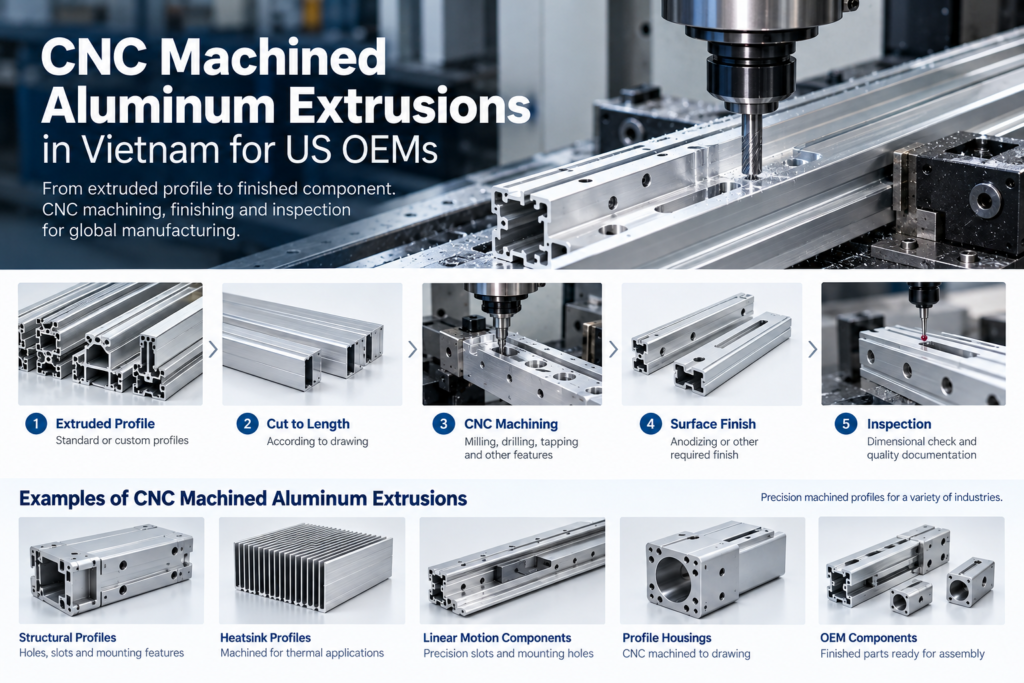
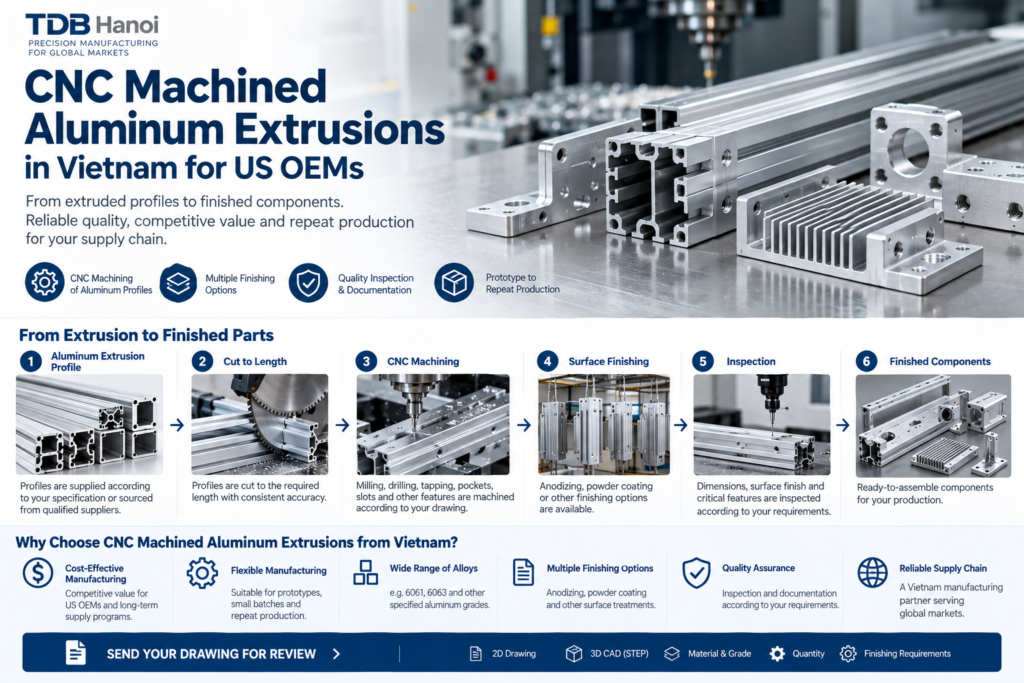
Aluminum Extrusion + CNC Machining: How Does the Process Work?
A typical manufacturing route can be:
Aluminum Profile → Cut to Length → CNC Machining → Surface Finishing → Inspection → Finished Component
Each stage performs a different function.
1. Aluminum Profile
The extrusion establishes the basic cross-sectional geometry of the component.
Depending on the project, this may be a standard profile or a custom profile manufactured according to customer requirements.
2. Cut to Length
The extruded profile is cut to the required component length.
Cutting strategy and allowance should consider subsequent machining and final dimensional requirements.
3. CNC Machining
Precision features are then added according to the engineering drawing.
Typical operations can include:
Milling → Drilling → Tapping → Pockets → Slots → Precision Interfaces
4. Surface Finishing
Depending on project requirements, machined aluminum components may require additional surface treatment.
Finishing requirements should be defined during quotation because they can influence dimensions, appearance, masking, inspection, and manufacturing sequence.
5. Inspection
Critical dimensions and features are inspected according to the drawing and agreed quality requirements.
6. Finished Component
The result is a machined aluminum profile ready for the customer’s next manufacturing or assembly operation.
Why Machine an Aluminum Extrusion Instead of Starting From Solid Stock?
Using an extrusion can be advantageous when a component has a consistent cross-section that would otherwise require substantial material removal from solid stock.
Imagine a long component containing:
- Internal channels
- Structural ribs
- Mounting rails
- Repeated wall sections
- Complex cross-sectional geometry
Machining the entire geometry from a solid block may require removing a significant amount of material.
An extrusion can create much of that cross-section before CNC machining begins.
CNC machining can then focus on the features that require localized precision.
This approach can potentially reduce:
- Material removal
- CNC machining time
- Chip generation
- Number of machining operations
However, extrusion is not automatically the best solution for every component.
Tooling, production quantity, geometry, tolerances, design changes, and supply requirements must all be considered.
What Types of Aluminum Extrusions Can Be CNC Machined?
Many profile-based components can require secondary CNC machining.
Examples include:
- Structural profiles
- Equipment frames
- Linear-motion components
- Electronic housings
- Heat-management components
- Mounting rails
- Automation components
- Machine structures
- Brackets
- Enclosures
- OEM equipment components
The correct manufacturing route depends on the actual engineering drawing rather than the product category alone.
CNC Machining Operations for Aluminum Profiles
CNC Milling
CNC milling can add features that cannot be produced through the extrusion cross-section itself.
These may include:
- Pockets
- Flat surfaces
- Slots
- Localized recesses
- Mounting interfaces
- Cutouts
Learn more about CNC Milling Services at TDB Hanoi.
Drilling
Drilling is frequently required for:
- Fasteners
- Assembly points
- Mounting
- Locating features
- Additional machining operations
Hole size, depth, position, and tolerance should be defined on the engineering drawing.
Tapping
Threads may be added after extrusion for assembly and fastening.
Thread requirements should identify the appropriate:
- Thread type
- Size
- Pitch
- Depth
- Through or blind condition
Precision Cutting
The final component length may itself be a controlled dimension.
Cutting and subsequent machining should therefore be planned together rather than treated as completely separate processes.
Aluminum Extrusion Tolerances vs CNC Machining Tolerances
This is one of the most important engineering considerations.
An extruded profile and a CNC-machined feature should not automatically be expected to have the same dimensional capability.
Extrusion creates the basic profile through a forming process.
CNC machining creates localized features through controlled material removal.
If a surface, hole, slot, or interface requires tighter control than the profile itself can provide, that feature may need secondary machining.
For example, a profile might contain an extruded reference surface, while a specific mounting interface requires additional CNC machining to meet the drawing requirement.
The drawing should therefore clearly distinguish:
Extruded Features vs Machined Features vs Critical Finished Dimensions
For demanding requirements, read our Tight Tolerance CNC Machining Guide.
GD&T for Machined Aluminum Profiles
Profile-based components can also contain geometric requirements.
Depending on the design, these may include:
- Flatness
- Straightness
- Parallelism
- Perpendicularity
- Position
- Profile
- Datum relationships
Long components can make datum strategy especially important.
The manufacturer needs to understand which features establish the functional reference system and which machined features must relate to those references.
Read our GD&T for CNC Machined Parts guide for more information.
What Should Be Included in the Drawing?
A clear engineering drawing is essential for CNC-machined aluminum profiles.
The manufacturing package should identify, where applicable:
- Finished dimensions
- Extruded geometry
- CNC-machined features
- Tolerances
- GD&T
- Datums
- Hole requirements
- Threads
- Surface finish
- Secondary finishing
- Critical characteristics
- Inspection requirements
- Drawing revision
Providing both the profile information and the finished-component requirements helps the manufacturer distinguish what comes from extrusion and what must be achieved through secondary machining.
See our CNC Machining Drawing Requirements guide.
Aluminum Alloy Selection
Material should be specified according to the engineering requirements of the component.
Different aluminum alloys can provide different combinations of:
- Strength
- Corrosion resistance
- Machinability
- Formability
- Surface-treatment response
- Cost
- Availability
The correct alloy should therefore be selected according to both the extrusion and finished-component requirements.
TDB Hanoi works with aluminum as part of our broader CNC Machining Materials capability.
For a more specific engineering comparison, see Aluminum 6061 vs 7075 for CNC Machining.
6061 vs 6063 for Extruded and Machined Components
US engineers frequently encounter both 6061 and 6063 aluminum in profile-based applications.
However, they should not be treated as interchangeable simply because both are common aluminum alloys.
The appropriate selection depends on factors including:
- Structural requirements
- Profile geometry
- Extrusion requirements
- Machining requirements
- Surface finishing
- Application environment
The drawing and material specification should identify the required alloy rather than leaving material selection to assumption.
If alternative materials are acceptable, they should be discussed during engineering review.
Surface Finishing for CNC Machined Aluminum Extrusions
Surface finishing should be considered early in the manufacturing process.
Depending on customer requirements, aluminum components may require finishing such as anodizing or other specified surface treatments.
The finishing process can affect:
- Appearance
- Corrosion protection
- Surface properties
- Critical dimensions
- Masking requirements
- Manufacturing sequence
Critical fits, threads, holes, and mating surfaces may require special consideration.
Read our CNC Machining Surface Finishes guide for additional information.
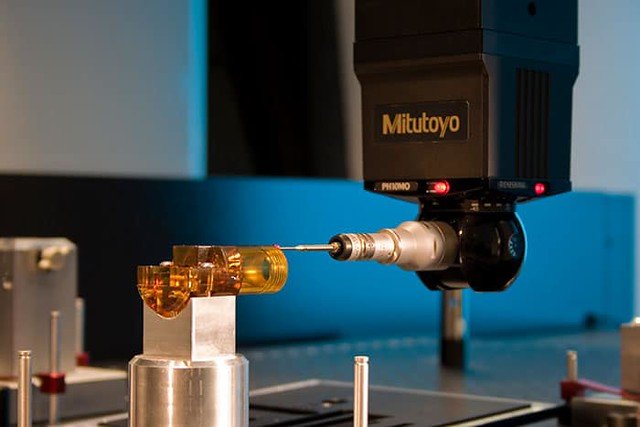
Inspection of CNC Machined Aluminum Profiles
Quality control should evaluate the finished component according to the drawing and agreed inspection requirements.
Depending on the project, inspection may involve:
- Overall dimensions
- Machined feature dimensions
- Hole positions
- Threads
- Critical interfaces
- Geometric requirements
- Surface requirements
- Visual requirements
- Project-specific documentation
The inspection strategy should reflect which characteristics are functionally important.
For international sourcing, buyers should define required documentation during RFQ rather than after production has begun.
Learn more about CNC Machining Quality Assurance at TDB Hanoi.
CNC Machined Extrusions for Repeat Production
The combination of extrusion and CNC machining can be particularly attractive for repeat-production programs.
Once the project has been established, repeat manufacturing can benefit from controlled:
- Material specification
- Profile sourcing
- Cutting
- CNC programs
- Fixtures
- Tooling
- Inspection methods
- Surface finishing
- Packaging requirements
For US OEMs with recurring annual demand, this can create a stable manufacturing route rather than sourcing each operation independently.
Prototype vs Repeat Production
One important consideration is whether the component is still in development or already moving into stable repeat production.
During early development, design changes may still occur.
If a custom extrusion die is required, engineering teams should consider whether the cross-sectional design is sufficiently stable before committing to tooling.
For prototypes or frequently changing geometry, machining from standard stock may sometimes offer greater flexibility.
Once the cross-section and annual demand become stable, extrusion combined with secondary CNC machining can become more attractive.
The decision should therefore consider the entire product lifecycle.
Should You Use a Standard or Custom Aluminum Profile?
Not every project requires a custom extrusion.
If an available standard profile already provides the required base geometry, it may be possible to:
Source Standard Profile → Cut → CNC Machine → Finish → Inspect
This can avoid custom extrusion tooling.
If the component requires a unique cross-section, a custom extrusion may be appropriate.
The decision depends on:
- Geometry
- Quantity
- Annual demand
- Tooling
- Material
- Lead time
- Design maturity
- Total manufacturing cost
Aluminum Extrusion + CNC vs Machining From Solid
Neither approach is automatically better.
Extrusion + CNC Machining
Can be attractive when:
- Cross-section repeats along the part
- Production is recurring
- Significant material would otherwise be removed
- Profile geometry can be created efficiently by extrusion
- Local precision features still require CNC machining
CNC Machining From Solid
Can be attractive when:
- Production quantity is low
- Design is still changing
- Geometry does not suit extrusion
- A custom die is difficult to justify
- Maximum design flexibility is required
We will explore this decision in more detail in our dedicated Aluminum Extrusion vs CNC Machining engineering guide.
Why US OEMs Source Machined Aluminum Components From Vietnam
US manufacturers increasingly evaluate global suppliers based on more than piece price.
A sourcing decision can involve:
- Manufacturing capability
- Quality control
- Engineering communication
- Repeat-production capacity
- Documentation
- Lead time
- Supply-chain diversification
- Total landed cost
Vietnam can form part of a diversified manufacturing strategy for companies seeking additional Asian production capacity.
However, supplier selection should be based on the specific project rather than country alone.
Read our CNC Machining Vietnam vs USA guide for a broader sourcing comparison.
US procurement teams can also review How to Source CNC Parts from Vietnam.
What Should US Buyers Ask an Aluminum Profile Machining Supplier?
Before selecting a supplier, ask:
1. Who controls the extrusion specification?
The supplier should understand the required profile, material, and finished-component requirements.
2. Which features will be CNC machined?
The drawing should distinguish profile geometry from precision-machined features.
3. How are critical dimensions inspected?
Inspection should be based on drawing requirements.
4. How are surface-finishing requirements controlled?
Finishing requirements should be established before production.
5. How are repeat orders controlled?
Revision, tooling, machining programs, inspection requirements, and other project information should remain controlled across repeat production.
6. What documentation is required?
Material and inspection documentation should be agreed during RFQ where required.
What Should You Send for an RFQ?
For CNC machined aluminum extrusion projects, provide as much of the following information as possible:
- Finished-component 2D drawing
- 3D CAD model
- Extrusion/profile drawing
- Material and alloy
- Part length
- Order quantity
- Annual forecast
- CNC machining requirements
- Tolerances
- GD&T
- Surface-finish requirements
- Secondary finishing
- Inspection requirements
- Documentation requirements
- Packaging requirements
- Delivery requirements
A complete RFQ allows the supplier to evaluate both the profile and secondary machining requirements.
See our CNC Machining RFQ Vietnam Guide.
CNC Machining of Aluminum Profiles at TDB Hanoi
TDB Hanoi is a precision manufacturing company in Vietnam serving global markets.
Our manufacturing operations include:
- CNC Milling
- CNC Turning
- Automated CNC Lathe machining
- CNC machining of custom components
- Contract Manufacturing
- Turnkey Manufacturing
- Quality inspection and manufacturing support
TDB Hanoi currently operates 50+ CNC machines with production capacity of up to 200,000 parts per month across our manufacturing operations.
For aluminum profile projects, our role can include CNC machining and manufacturing support according to the customer’s drawing and agreed project requirements.
Where the project requires an extruded profile, the extrusion specification and sourcing route should be defined during project review.
TDB Hanoi should not be interpreted as claiming that aluminum extrusion itself is performed in-house unless explicitly confirmed for the individual project.
This distinction allows US buyers to understand clearly which manufacturing stages are being evaluated and controlled.
Frequently Asked Questions
What is a CNC machined aluminum extrusion?
A CNC machined aluminum extrusion is an extruded aluminum profile that receives secondary CNC machining to create features such as holes, threads, slots, pockets, mounting surfaces, and other precision geometry required by the finished component.
Can aluminum extrusions be CNC machined?
Yes. CNC machining is commonly used to add localized precision features to aluminum profiles after extrusion.
Why use extrusion before CNC machining?
When a component has a repeated cross-section, extrusion can create much of the base geometry before CNC machining. CNC operations can then focus on the features requiring additional precision.
Is extrusion better than machining aluminum from solid stock?
Not always. The correct process depends on geometry, quantity, tooling, design maturity, tolerances, lead time, and total manufacturing requirements.
Can CNC machining improve the precision of an extruded profile?
CNC machining can create controlled local features and surfaces according to the drawing. It does not automatically change the dimensional characteristics of portions of the profile that remain as-extruded.
What information should I send for a machined aluminum extrusion quotation?
Send the finished-part drawing, CAD model, profile drawing where available, alloy, quantity, annual forecast, tolerances, finishing, inspection requirements, and required documentation.
Does TDB Hanoi manufacture aluminum extrusions?
TDB Hanoi provides CNC machining and manufacturing support for aluminum components and profiles. For projects requiring an extruded profile, the extrusion source and project responsibilities should be confirmed during quotation rather than assuming extrusion is performed in-house.
Can TDB Hanoi support repeat production?
Yes. TDB Hanoi supports repeat manufacturing programs and operates more than 50 CNC machines with production capacity of up to 200,000 parts per month across its manufacturing operations.
Send Your Aluminum Profile Project to TDB Hanoi
If your project requires an extruded aluminum profile followed by precision CNC machining, send TDB Hanoi your manufacturing package for review.
Please include:
2D Drawing · 3D CAD · Profile Drawing · Aluminum Alloy · Quantity · Annual Forecast · Tolerances · Surface Finish · Inspection Requirements
Our team can review the CNC machining and manufacturing requirements before quotation.